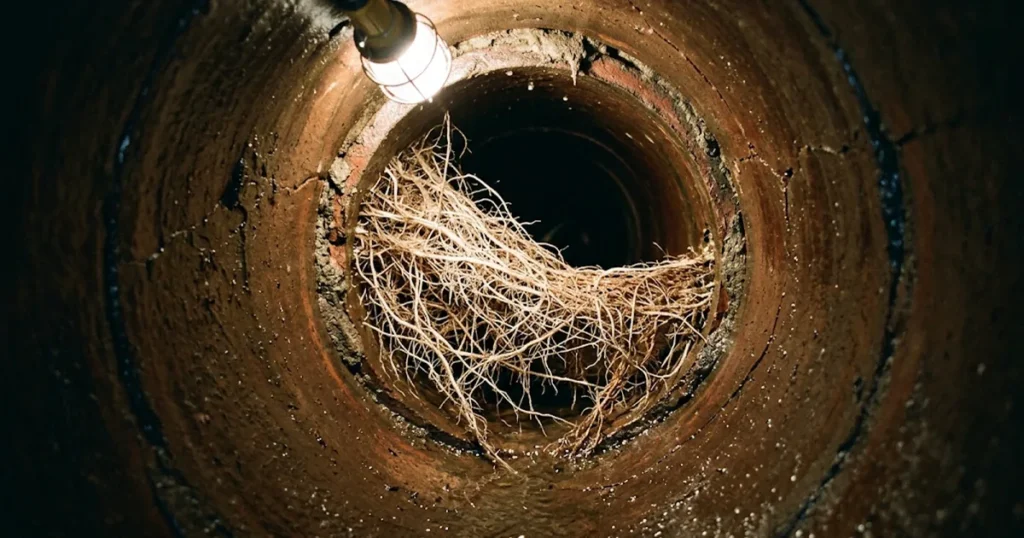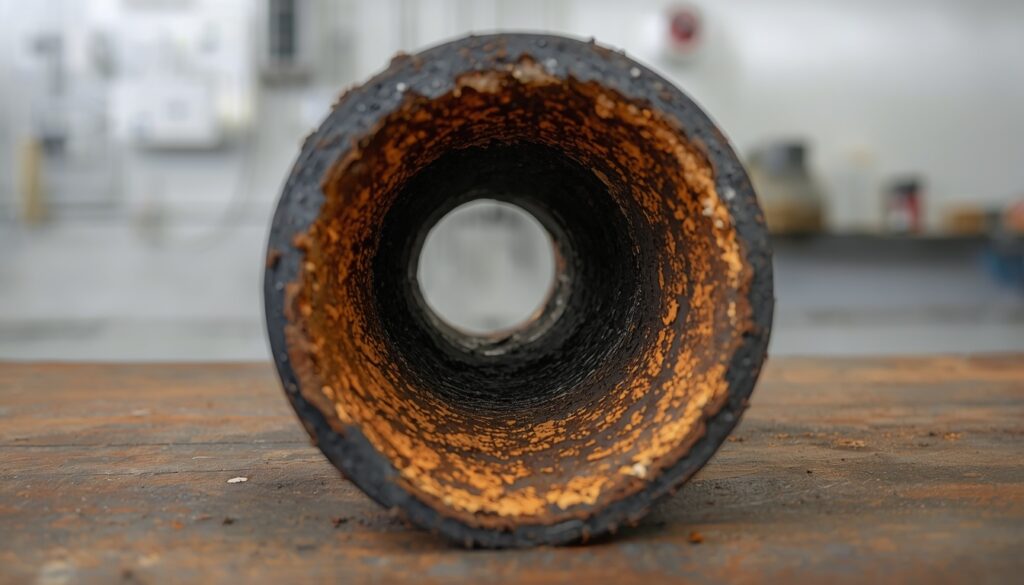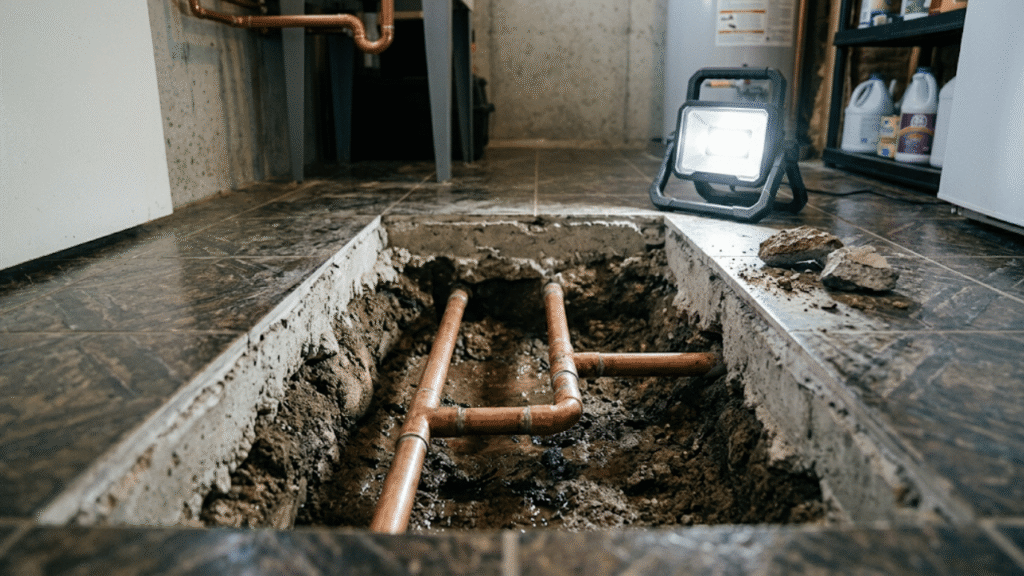
Four trenchless methods handle almost all residential and commercial pipe repair: pipe bursting for sewer lines, pipe bursting (or pulling) for water lines, CIPP pipe lining, and pipe coating. Bursting replaces the old pipe. Lining and coating rebuild it from the inside. A camera inspection decides which one a given pipe can take.
This page is the short version of each method and when it applies. Each section links to the full guide if you want the detail.
What is trenchless technology?
Trenchless technology repairs or replaces underground pipe without digging up the whole pipe path. Technicians work through a small access hole at one end of the run, sometimes at both ends, and sometimes through an existing cleanout with no digging at all.
How much excavation a job needs depends on the method and the pipe condition. Two access pits is typical for bursting. One access point is common for lining. Zero excavation happens when a cleanout is already in place.
More on the approach in our no-dig sewer line repair guide.
| Method | What it does | Best for | Typical lifespan |
|---|---|---|---|
| Pipe bursting (sewer) | Pulls new pipe through while breaking the old one outward | Cast iron, clay, Orangeburg, badly degraded sewer lines | 50-100+ years |
| Pipe bursting (water) | Same concept, smaller diameter, for the water service line | Quest polybutylene, old copper, failing PVC | 50+ years |
| Pipe lining (CIPP) | Cures a resin liner inside the old pipe to form a new one | Cracked, leaking, root-intruded pipe that still holds its shape | 50+ years |
| Pipe coating | Sprays a thin epoxy layer onto the pipe interior | Galvanized water lines, cast iron spot repairs | 10-30 years |
Pipe bursting for sewer lines
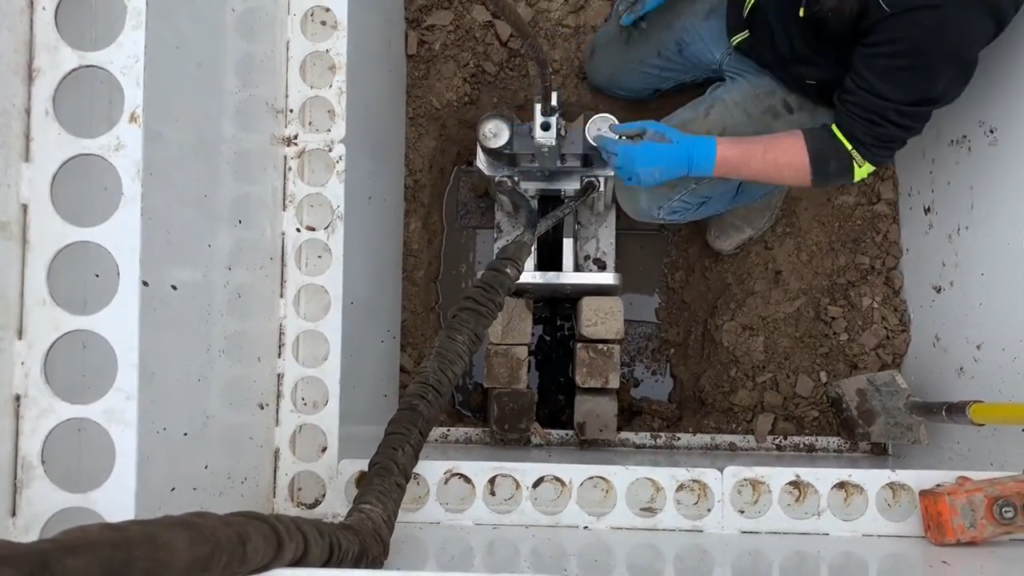
Pipe bursting replaces the sewer line entirely. A cone-shaped bursting head is pulled through the old pipe, fracturing it outward into the surrounding soil, while new pipe is pulled in behind it along the same path. The fragments of the old pipe stay in the ground.
The new pipe is almost always fusion-welded HDPE, welded into one continuous length before it goes in. That matters for one reason above all others: no joints between the endpoints means no path for tree roots. The American Society of Civil Engineers recognizes fusion-welded HDPE as one of the most reliable materials for buried infrastructure.
Bursting will not fix a belly. If the line has sagged below grade, the new pipe follows the same sag. It also jams on runs with more than two or three 45-degree bends, and it struggles in heavily compacted or rocky soil.
Full detail, including why the method was developed for Orangeburg pipe: what is pipe bursting.
Pipe bursting for water lines
Water line bursting, often called pipe pulling, uses the same principle at smaller scale. Diameters run 3/4″ to 2″ rather than 2″ to 4″, the new pipe comes in continuous 100 to 300 foot rolls rather than welded sections, and the bursting force is lower because it is breaking soft plastic rather than cast iron.
The method became standard because of Quest polybutylene. Builders installed it widely in the 1980s as a copper replacement, the product was manufactured with walls too thin to last, and millions of those lines are still in the ground failing decades later.
The replacement line has no buried joints, connecting only at the meter box and the house entry. Buried joints that corrode or shift are the most common failure point in older water service lines.
Pipe lining (CIPP)
CIPP does not replace the pipe. It builds a new one inside it. A flexible resin-saturated liner goes in through an access point, inflates against the host pipe wall, and cures into a smooth jointless inner pipe.
Two curing methods are in use. Traditional epoxy CIPP hardens chemically over 3 to 12 hours and requires precise resin mixing and a dry pipe. UV-cured CIPP uses a UV LED light train pulled through a pre-saturated liner, cures in under an hour, tolerates moisture in the pipe, and produces glass-reinforced pipe (GRP) rather than felt-and-epoxy. UV has become the preferred method for new installations for those reasons.
CIPP is the method for pipe that is damaged but structurally present: cracks, root intrusion at joints, corroded cast iron, runs with multiple bends, and anything under a slab or driveway where excavation means breaking concrete.
Installations should meet ASTM F1216 and ASTM F2019. Ask any contractor about ASTM compliance before signing.
More detail: how CIPP pipe lining works and UV pipe lining benefits.
Pipe coating
Pipe coating sprays liquid epoxy onto the inside of an existing pipe, where it cures into a thin protective layer in 5 to 10 minutes. It is the oldest of these methods and it is being phased out of residential sewer work.
The reason is structural. Coating has no fiberglass reinforcement, so it is a surface layer rather than a new pipe. It does not reliably bridge a hole or a gap, and it requires the pipe to be completely dry, which is difficult in a line that is leaking.
It still has real uses: galvanized water lines in older commercial buildings, small-diameter pipe that CIPP equipment cannot handle, short cast iron spot repairs, and NSF-certified applications on commercial drinking water lines.
Side by side comparison: pipe lining vs pipe coating.
How the four methods compare
| Feature | Bursting (sewer) | Bursting (water) | Lining (UV CIPP) | Coating |
|---|---|---|---|---|
| Replaces old pipe? | Yes | Yes | No | No |
| New material | HDPE, fusion welded | HDPE, rolled | GRP fiberglass | Liquid epoxy |
| Pipe sizes | 2″-12″+ | 3/4″-2″ | 2″-24″+ | 3/4″-4″ |
| Excavation | 2 access pits | 2 access pits | 1-2 access points | 1-2 access points |
| Cure or install time | 1-2 days | 1-2 days | Under 1 hour cure | 5-10 min cure |
| Wet pipe tolerance | N/A | N/A | High | None |
| Bridges cracks and gaps | N/A | N/A | Yes | Limited |
| Handles bellies | No | No | Limited | No |
| Handles 45° bends | Up to 2-3 | Up to 2-3 | Many | Many |
| Expected lifespan | 50-100+ years | 50+ years | 50+ years | 10-30 years |
| Best for | Cast iron, Orangeburg, clay | Quest polybutylene, old copper | Cracked, root-intruded, corroded | Galvanized water, spot repairs |
Methods get combined on real jobs. A common pairing in DFW is bursting the yard run from house to street, then lining the section under the slab.
Which methods work best in DFW soil?
CIPP handles the majority of Dallas-Fort Worth residential sewer failures, because the damage pattern here is joint separation rather than collapse. North Texas expansive clay shrinks through a dry summer and swells after rain, and that movement pulls rigid cast iron and clay joints apart while the pipe body stays intact. A pipe that still holds its bore lines well.
Across 200+ trenchless jobs in the DFW Metroplex, Nuflow DFW has found cast iron in pre-1975 homes failing at an average of 58 years.
Three local conditions drive the method choice:
- Slab foundations. Most post-1960 DFW construction sits on slab, which makes excavating a line underneath expensive enough that lining wins on cost before landscaping is counted.
- Mature trees in older neighborhoods. Roots enter through separated joints. Both lining and bursting close the entry point because both produce a jointless run. Clearing roots alone does not.
- Clay movement creating bellies. The same shrinkage that separates joints drops sections into low spots, and a belly rules out both lining and bursting.
We run these methods across Dallas, Fort Worth, and 23 other cities in the Metroplex.
What does trenchless repair cost?
The camera inspection sets the price, because the method depends on what the footage shows. Nuflow DFW starting figures as of Q3 2026:
| Service | Starting price |
|---|---|
| Camera inspection | $250+ |
| Drain cleaning | $150+ |
| Hydro jetting | $350+ |
| Trenchless pipe lining (CIPP) | $3,500+ |
Most residential CIPP jobs land between $3,500 and $15,000. Footage, depth, whether a usable cleanout exists, and how much scale and root has to come out before the liner will bond all move the number. Actual cost depends on inspection findings, and Nuflow DFW gives a written price before any work starts.
Why inspection quotes vary so widely between companies: sewer scope inspection cost.
What trenchless cannot do
Some situations still need excavation, and any contractor claiming otherwise is selling rather than diagnosing:
- Severely collapsed pipe with no opening for a liner or bursting head to pass through
- Significant bellies that need physical regrading
- More than three sharp 45-degree turns in the run
- Heavily offset joints that block equipment
- Lines that need rerouting onto a different path
- Upgrades to a much larger diameter than the existing pipe
A camera inspection tells you which method your line needs. Call Nuflow DFW at (469) 701-0597 or use the contact page to schedule. Ryan King holds a Texas Responsible Master Plumber license, RMP# 46694. Service is scheduled Monday to Friday, 9:00 a.m. to 6:00 p.m.
Frequently asked questions
What is the difference between pipe bursting and pipe lining?
Pipe bursting replaces the old pipe entirely, pulling new pipe along the same path while a bursting head fractures the existing one outward into the soil. Pipe lining cures a structural liner inside the existing pipe, which stays in place. Bursting is replacement; lining is rehabilitation.
Is pipe coating the same as pipe lining?
No. Coating sprays a thin epoxy layer onto the pipe interior, like painting the inside surface. Lining installs a fiberglass-reinforced liner that becomes a complete new pipe inside the old one. CIPP is significantly stronger, and coating is being phased out of most residential sewer work.
How much does trenchless pipe repair cost in DFW?
Trenchless pipe lining starts at $3,500+, with most residential jobs landing between $3,500 and $15,000 (as of Q3 2026). Footage, depth, access, and pipe condition set the final figure. A camera inspection starting at $250+ determines both the method and the price.
Which trenchless method suits a home on a slab foundation?
CIPP lining, in almost every case. A sewer line under a concrete slab makes excavation expensive and disruptive, and bursting under a slab works only in narrow circumstances. The liner installs through an existing cleanout without breaking concrete.
Can any pipe be repaired without digging?
No. Bursting needs a relatively straight run with no major bellies and fewer than three or four sharp bends. Lining needs the existing pipe to be at least partially intact rather than fully collapsed. Coating needs a fully dry pipe. A camera inspection is the only reliable way to know.
How long does trenchless repair last?
UV-cured CIPP liners are rated for 50 years or more. Fusion-welded HDPE from pipe bursting lasts 50 to 100 years or more. Pipe coating typically lasts 10 to 30 years depending on conditions. All three exceed the remaining life of the cast iron and clay they usually replace.