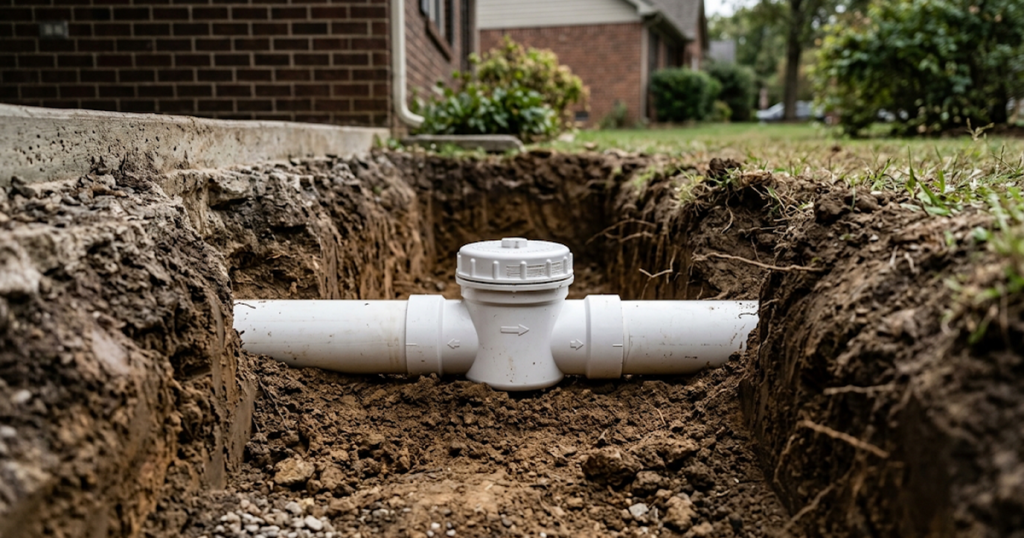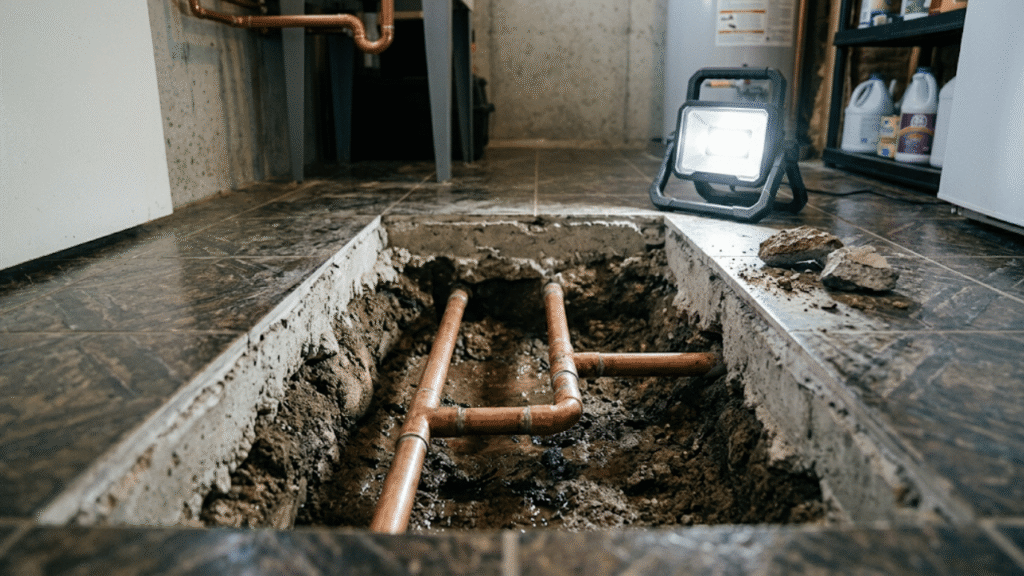
A slab leak, sometimes called a slab plumbing leak, is a water line leaking underneath your home’s concrete foundation. The pipe is buried in or below the slab, so the water has nowhere to go but sideways into the soil or up through the concrete. In DFW, where nearly every home sits on a slab, they are one of the most common serious plumbing failures we see. Leak Detection starts at $750+ and repair typically runs $1,500 to $4,500.
The part most homeowners get wrong is assuming all slab leaks behave the same way. They do not, and the difference determines whether you can even detect it yourself.
What is a slab leak, exactly?
A slab leak is any leak in the plumbing that runs through or beneath a concrete foundation slab. You will also see it called a slab plumbing leak, a slab water leak, or simply a water leak under the slab. They all describe the same thing. Two separate systems pass under there: pressurized supply lines carrying water to your fixtures, and drain lines carrying waste away. A leak in either counts, but they behave in completely different ways.
The pipe is inaccessible by design. It was laid before the concrete was poured, which is why locating a leak takes equipment rather than a visual inspection, and why repair costs what it does.
Why DFW sees so many of them
Almost all housing built in North Texas since the 1960s is slab-on-grade. There is no basement, no crawlspace, and no easy access. Combine that construction with the soil underneath and you get the conditions for slab leaks at a rate most of the country does not see.
What causes a slab leak?
Three forces act on a pipe under a DFW slab, and most failures involve at least two of them.
Clay soil movement
North Texas sits on expansive clay. It swells when it takes on water and shrinks when it dries out, and the seasonal swing between those states is severe here. Late summer, after months of heat and no rain, the soil is at maximum shrinkage and has pulled away from the foundation. The first heavy autumn rains then swell it again, fast.
Every one of those cycles puts mechanical stress on the pipes running through it. Joints work loose. Copper that is pinned by concrete on one side and moving soil on the other eventually gives. This is why slab leak calls cluster seasonally rather than spreading evenly through the year.
Copper corroding from both directions
Most DFW homes built from the 1970s onward have copper supply lines. Copper is durable but not immune, and under a slab it gets attacked from two sides at once.
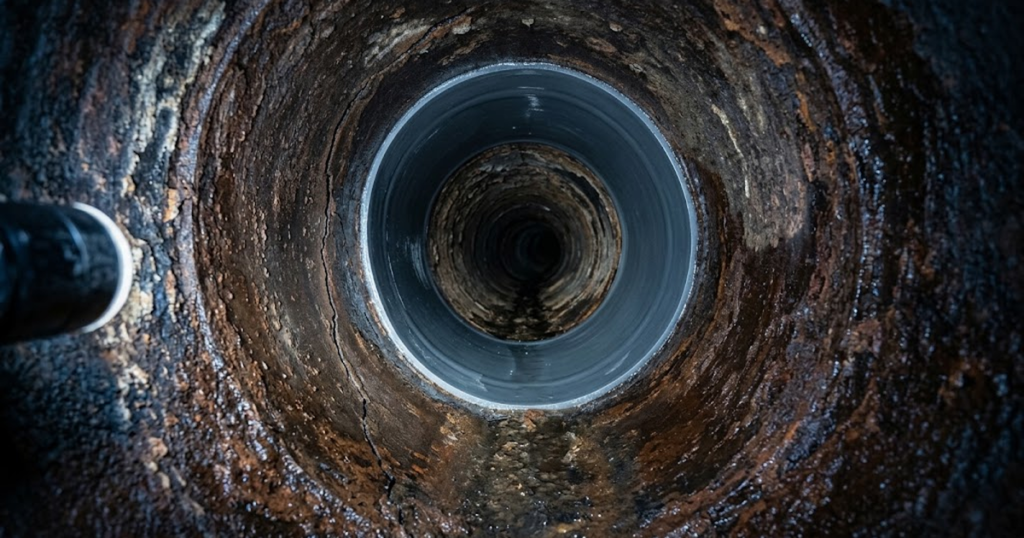
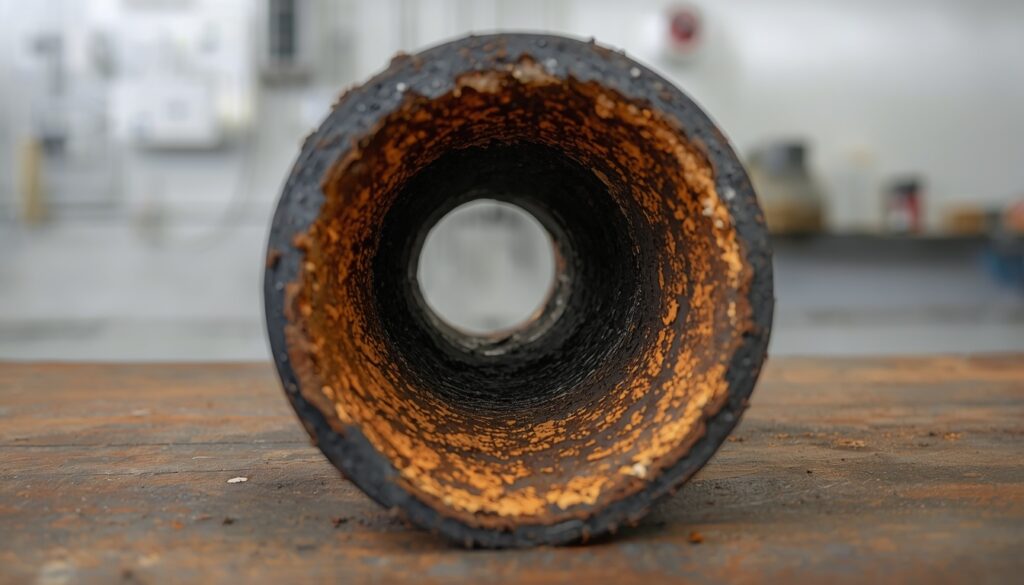
From the outside, soil chemistry and oxygen levels corrode buried copper, and contact with concrete and rebar can drive galvanic corrosion. From the inside, hard water does the work. Dallas Water Utilities reports average hardness around 8.9 grains per gallon, with several suburbs testing higher, and that mineral load plus water velocity gradually thins the pipe wall from within.
The result is a pinhole: a perforation one to three millimetres across that leaks slowly for months before anyone notices.
Age and installation
Copper under a slab commonly starts failing somewhere past the twenty-year mark, earlier where the water is harder or the install was rough. Pipes bent too sharply, laid against rebar, or backfilled with rocky material all fail sooner.
Is it a pressure leak or a drain leak?
This distinction decides everything about how the leak behaves and whether you can find it, and almost nobody explains it.
A pressure-side leak is in a supply line. Those lines are under constant pressure whether or not anyone is using water, so the leak runs 24 hours a day. It will show on your water meter, it wastes water continuously, and it usually announces itself through a rising bill.
A drain-side leak is in a waste line. Drain lines are not pressurized. They only carry water when a fixture is running, so the leak is intermittent. It will not move your water meter, because that water already passed through the meter on its way to the fixture.
| Pressure side | Drain side | |
|---|---|---|
| Leaks constantly | Yes | Only when water runs |
| Shows on the water meter | Yes | No |
| Raises the water bill | Yes | No |
| Common first sign | High bill, warm floor | Damp floor, odor, foundation movement |
Why the water meter test misleads people
That second column is why the standard advice to shut everything off and watch the meter gives false negatives. A still meter rules out a pressure leak. It tells you nothing about a drain leak. Our walkthrough of how to check for a slab leak yourself covers the meter test and its limits in detail.
What are the signs of a slab leak?
Seven things homeowners notice, roughly in the order they usually appear.
- A water bill that climbed with no change in usage. The most common first sign, and pressure-side only.
- A warm spot on the floor. Almost always a hot water line, for reasons covered below.
- The sound of running water when nothing is on. Stand still in a quiet house and listen at floor level.
- Damp carpet, buckling wood, or loose tile with no spill to explain it.
- A musty smell from moisture trapped under flooring.
- Low water pressure across the house as the leak bleeds off supply.
- New cracks in walls, floors, or the foundation, which means the leak has been running long enough to move the soil.
That last one is the reason not to wait. Water escaping under a slab saturates the clay in one spot while the surrounding soil stays dry, and that uneven swelling lifts part of the foundation. A plumbing repair becomes a foundation repair, and the cost difference is an order of magnitude.
Why hot water lines fail first
If you find a warm patch on the floor, that is a hot line, and hot lines fail disproportionately often. Higher water temperature accelerates the chemical reactions that corrode copper from the inside, so a hot line ages faster than the cold line running beside it.
It is also the only slab leak you can sometimes detect barefoot, which makes it the one people catch earliest.
How serious is a slab leak?
Serious enough to act on, not serious enough to panic on day one. A slab leak will not flood your house overnight. What it does is compound, and the compounding is what turns a plumbing bill into a structural one.
What happens if you leave it
Water escaping under a foundation saturates one patch of clay while the surrounding soil stays dry. Expansive clay swells when it takes on water, so that patch lifts while the rest of the slab does not. Uneven movement is what cracks foundations, and foundation repair costs an order of magnitude more than pipe repair.
Three other things happen alongside it. A pressure-side leak wastes water continuously, which shows on every bill until it is fixed. Moisture trapped under flooring feeds mold. And on a hot water line you are paying to heat water that never reaches a tap.
When it becomes urgent
Move faster if you see new cracks in walls, floors, or the foundation, doors or windows that have started sticking, or flooring that is lifting or buckling. Those mean the soil has already moved. At that point you are no longer only deciding about a pipe.
A slab leak caught in its first weeks is a repair. One that has run for a year can be a repair plus flooring plus foundation work.
How much does a slab leak cost to fix?
Detection starts at $750+ (as of Q3 2026). Repair typically runs $1,500 to $4,500 depending on which route makes sense for your pipe. Access, flooring type, how deep the line sits, and how many leaks the run has already had all move the number.
Spot repair opens the floor at the confirmed leak, replaces that section, and patches. It is the cheaper option and the right one for a first leak in a line that is otherwise sound.
Rerouting abandons the failing run under the slab and routes new pipe overhead through walls and attic instead. It costs more upfront and it ends the problem permanently. It is the honest answer when a home has already had one slab leak, because a second leak in the same line means the whole run is corroding, not just the spot that failed.
The honest version: if you have had one slab leak in a twenty-five-year-old copper line, spot-repairing it means you will probably be back here within a few years. We would rather tell you that before the first repair than after the second. Our Garland slab leak repair services walks through how that decision plays out on a real job.
Where we see slab leaks across DFW
Slab leaks cluster in the parts of the Metroplex where housing age and soil conditions line up. Slab-on-grade construction plus expansive clay plus copper supply lines past the twenty-year mark is the combination, and most of DFW has all three.
Fort Worth has large stretches of mid-century housing on Eagle Ford and Woodbine clay, both of which move considerably between wet and dry seasons. Older sections around the Near Southside, Arlington Heights and Ridglea see plenty of slab plumbing leaks for exactly that reason.
Plano, Richardson and Addison built out heavily through the 1970s and 1980s, which puts a large share of their copper supply lines right in the failure window now. Addison’s older condo and townhome stock is a particular case, because a leak under a shared slab can affect more than one unit and the repair decision involves an HOA.
Garland, Irving and Mesquite have similar 1960s and 1970s housing, often with the original copper still in place under the slab.
Dallas spans the widest range. Pre-war East Dallas and Oak Cliff homes often have cast iron drain lines alongside copper supply, so a leak there can be either system, and the diagnosis matters more than in newer areas.
The common thread is not the city. It is the combination of an older home, a slab foundation, and soil that moves with the seasons. If your house checks all three, a slab leak is a maintenance question rather than bad luck.
Does homeowners insurance cover slab leaks?
Usually it covers the water damage, and usually it does not cover the pipe.
Most Texas policies pay for damage caused by a sudden leak, flooring, drywall, and often the cost of accessing the pipe, which is called tear-out coverage. What they typically exclude is the repair of the failed pipe itself, and damage from a leak that was gradual rather than sudden. Since slab leaks are almost always gradual by nature, that distinction matters and it is worth reading your policy before you file.
Documentation helps. A written detection report showing where and when the leak was found supports the claim far better than a description after the fact.
What to do if you suspect one
Do not start breaking concrete, and do not ignore a rising bill.
Check the meter, then get it located
Shut off every fixture in the house and check your water meter. If the dial is still moving, you have a pressure-side leak somewhere. If it is still, you may still have a drain-side leak, and that needs equipment to confirm.
Then get it located before anything is opened. Slab leak detection uses acoustic listening, thermal imaging, and line pressure testing to pinpoint the spot, which is what makes a targeted repair possible instead of exploratory demolition.
Nuflow DFW is licensed by the Texas State Board of Plumbing Examiners (RMP# 46694) and provides a written estimate after diagnosis, before any work begins. Call (469) 701-0597.
Frequently Asked Questions
What is a slab leak?
A slab leak is a water line leaking underneath a home’s concrete foundation, in either a pressurized supply line or a drain line. The pipe sits in or below the slab and is inaccessible without equipment, which is why locating one requires acoustic, thermal, or pressure testing rather than a visual inspection.
What causes slab leaks in Texas homes?
Three things, usually together. Expansive clay soil swells and shrinks seasonally, stressing pipes buried in it. Soil and concrete chemistry corrode copper from the outside. Hard water thins the pipe wall from the inside. Copper under a DFW slab commonly begins failing past the twenty-year mark.
Can I detect a slab leak with my water meter?
Only a pressure-side leak. Supply lines are pressurized constantly, so that leak moves the meter with every fixture off. Drain lines are not pressurized and only leak when water is running, so a drain-side slab leak will not move the meter at all. A still meter does not rule one out.
Why is my floor warm in one spot?
That is the classic sign of a hot water line leaking beneath the slab. Hot lines fail more often than cold ones because higher temperature accelerates the corrosion thinning the copper from inside. A warm patch with no heating source under it warrants a detection call rather than watching it.
How much does slab leak repair cost?
Detection starts at $750+ and repair typically runs $1,500 to $4,500 as of Q3 2026, depending on whether a spot repair or a full reroute is the right answer. Access, depth, flooring type, and how many leaks the line has already had all move the final number. Here is how long slab leak repair takes for each option.
Are slab leaks dangerous?
Not immediately, but they get expensive fast. Water escaping under a foundation saturates clay soil unevenly, which lifts part of the slab and can turn a plumbing repair into a foundation repair. Trapped moisture also feeds mold under flooring. Neither is urgent on day one; both compound over months.
How much does a slab leak cost to fix?
Detection starts at $750+ and repair typically runs $1,500 to $4,500 as of Q3 2026. A spot repair sits at the lower end and a full reroute at the upper. Flooring type, slab depth, access, and whether the line has leaked before all move the final figure.
Should I repair or reroute a slab leak?
Spot repair suits a first leak in an otherwise sound line. Rerouting overhead suits a home that has already had one slab leak, or has old copper throughout, because a second leak means the whole run is failing rather than one section. Age and leak history decide it, not the current leak.
The thing worth acting on
A slab leak found early is a plumbing job. A slab leak found after it has been running for six months can be a foundation job, and those are not the same order of expense.
If your water bill has climbed with no explanation, or there is a warm patch on your floor, get it located. Detection is a known cost and it produces an answer. Guessing produces a hole in your floor.
Nuflow DFW. Licensed Master Plumber, RMP# 46694. Call (469) 701-0597.