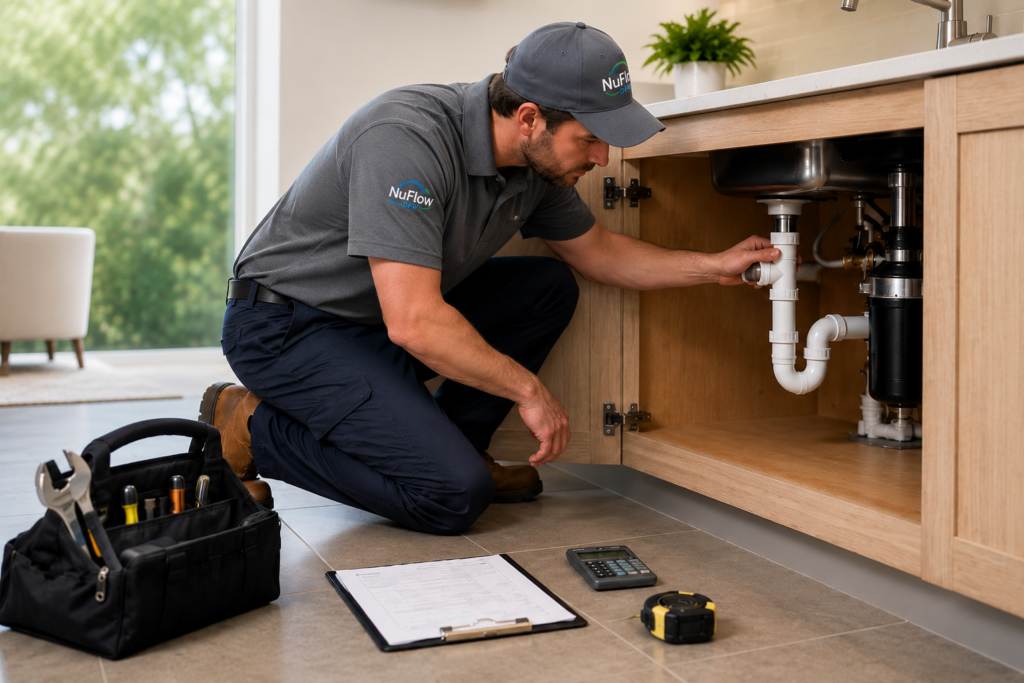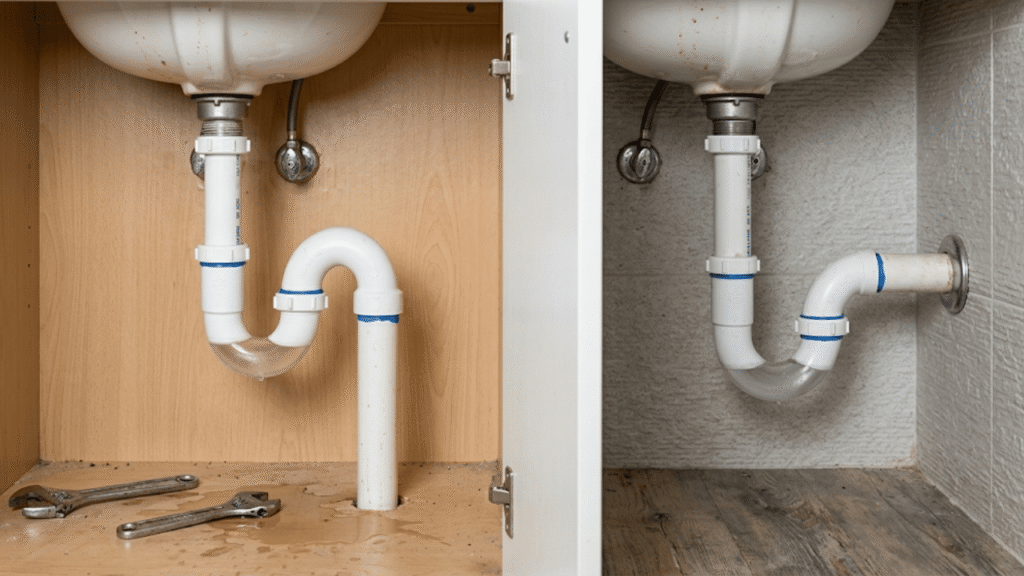
Look at the pipe under your sink. If it curves down, back up, and then drops straight down through the floor, that is an S-trap, and current plumbing code prohibits it. If it curves down, back up, and then runs sideways into the wall, that is a P-trap, and it is the only shape approved for new work. Both hold water to block sewer gas. Only one holds onto it reliably.
We still find S-traps under original sinks in pre-1970s homes across East Dallas, Oak Cliff, and older parts of Garland and Irving. Usually the homeowner called about a smell.
The difference is the direction the pipe leaves
Both traps are a U-bend holding a small pool of water. That pool is the trap seal, and it is the only barrier between your kitchen and the sewer. The shapes diverge in what happens after the bend.
| S-trap | P-trap | |
|---|---|---|
| Exit direction | Straight down | Horizontal into the wall |
| Vented | No | Yes, through the trap arm |
| Code status | Prohibited | Required |
| Common in | Pre-1970s homes | Everything since |
| Failure mode | Siphons itself dry | Dries only from disuse |
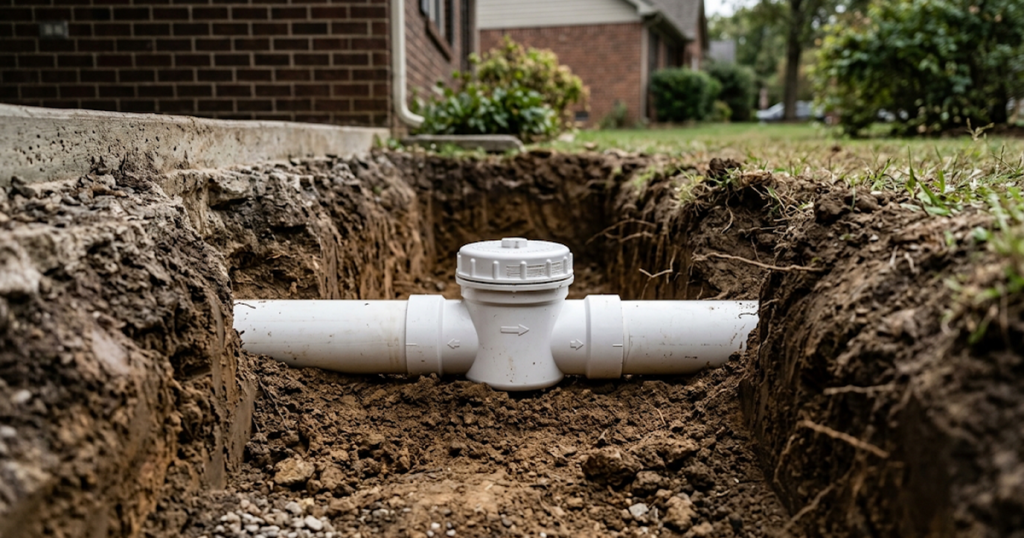
The horizontal run on a P-trap is the trap arm, and it carries waste to a vent connection. That vent is the entire difference. It lets air in behind the draining water so the water cannot pull the seal out with it.
What the trap seal actually is
The water sitting in the bend is measured from the weir, which is the crest the water spills over on its way out, down to the top of the dip. Code requires that seal to be 2 to 4 inches deep (IPC Section 1002.4). Shallower and it blows out under pressure. Deeper and the trap struggles to self-scour, so solids settle in the bend.
Two inches of water is all that stands between you and the sewer line. It is a small margin, and it explains why so many odor complaints trace back to something this simple.
Why S-traps are prohibited
An S-trap has no vent. When a full sink drains, the column of water dropping down the vertical pipe creates suction behind it, and with no air source, the only air available comes through the trap itself. The draining water pulls the seal out with it. Come back in an hour and the bend is empty, with an open pipe to the sewer running into your kitchen.
Both major US codes prohibit them. The IPC bans S-traps at Section 1002.3, and the UPC at 1004.1.
Plumbers did try to fix this. The crown vent, a vent tapped into the top of the trap bend itself, was the historical workaround, and it failed because it sat where draining water splashed up into it and clogged it. Crown vents are now prohibited by the same code sections that prohibit S-traps. If you find one in an old house, it was somebody’s attempt at a repair, not the original design.
The code numbers most articles get wrong for DFW
Here is where nearly every article on this topic gives DFW readers the wrong information.
Search “trap arm length” and the results quote UPC Table 1002.2: 30 inches for 1¼-inch pipe, up to 10 feet for 4-inch. Those are real numbers from a real code, and they do not apply to your house.
Dallas, Fort Worth, and San Antonio all run on the International Plumbing Code, not the Uniform Plumbing Code. Dallas and Fort Worth are on the 2021 IPC with local amendments, and Plano has already adopted the 2024 edition. The governing table here is IPC Table 909.1, and the numbers are considerably more generous:
| Trap arm size | Max distance to vent (IPC) | Required slope |
|---|---|---|
| 1¼ inch | 5 feet | ¼ in. per foot |
| 1½ inch | 6 feet | ¼ in. per foot |
| 2 inch | 8 feet | ¼ in. per foot |
| 3 inch | 12 feet | ⅛ in. per foot |
| 4 inch | 16 feet | ⅛ in. per foot |
A homeowner in Plano reading a UPC-based article would think a 4-foot run on a 1¼-inch arm is a violation. Under the code their city actually enforces, it is fine. Worth knowing which rules apply to you before any permitted work, since Texas plumbing code is adopted city by city rather than statewide.
There is a second rule that catches more real installations than the length limit does. The trap arm cannot fall more than one pipe diameter across its whole run. Drop it further and the vent connection ends up sitting below the trap weir, which means the trap self-siphons even though the length is legal. Plenty of DIY sink relocations pass the tape measure and fail on this.
How a P-trap goes dry, and how fast
A P-trap only loses its seal for one of three reasons: nobody uses the fixture, the vent is blocked so it siphons anyway, or the fixture leaks somewhere below the weir.
Disuse is the common one. Guest bathrooms, floor drains, laundry sinks, and second-floor showers in rental property. In a North Texas summer with air conditioning running continuously, an unused trap can evaporate dry in three to four weeks. Winter buys you longer.
The fix costs nothing. Run the tap for fifteen seconds. For a drain you barely touch, add a couple of tablespoons of cooking oil afterward, which floats on the seal and slows evaporation considerably.
The other traps still sitting in old DFW houses
Drum traps show up under bathtubs in homes built before roughly 1950, a cylinder with a screw-off lid set into the floor. They hold far more water than a P-trap and they clog readily because they do not self-scour. Prohibited now, and generally replaced when the bathroom gets touched.
Bell traps appear in old floor drains, a cup inverted over a standpipe. The cup lifts out easily during cleaning, and once it is gone the drain is a direct opening to the sewer with nothing sealing it.
Double-trapping is a fault we see fairly often after DIY work. Somebody adds a P-trap under a fixture that already has one, usually a toilet or a bathtub. Air gets sealed between the two traps and the fixture drains slowly forever, with no clog to find. Code prohibits it, and the fix is removing one, not snaking the line.
When the trap is not the problem
This is the part worth reading before you spend a weekend under the sink.
Refill a dry trap and the smell should go and stay gone. If it comes back within twenty-four hours, the trap was never the source. Sewer gas is entering somewhere else, and the two usual candidates are a blocked vent stack or a cracked drain line. That distinction matters because it changes the job entirely.
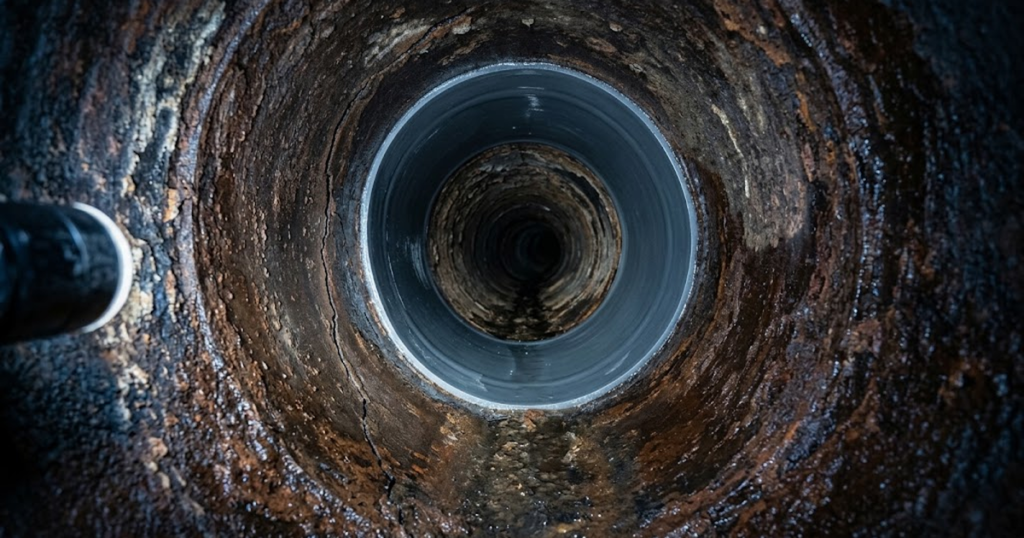
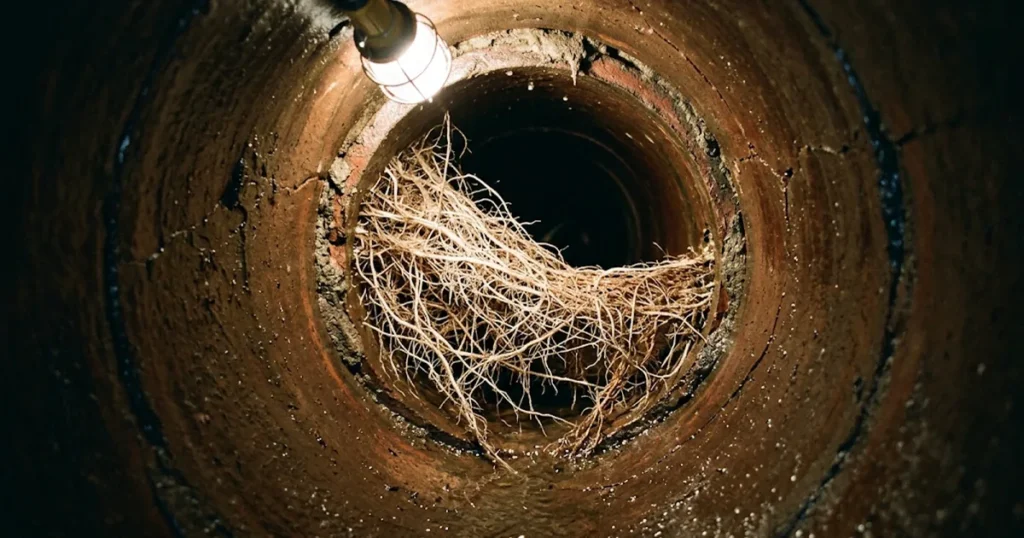
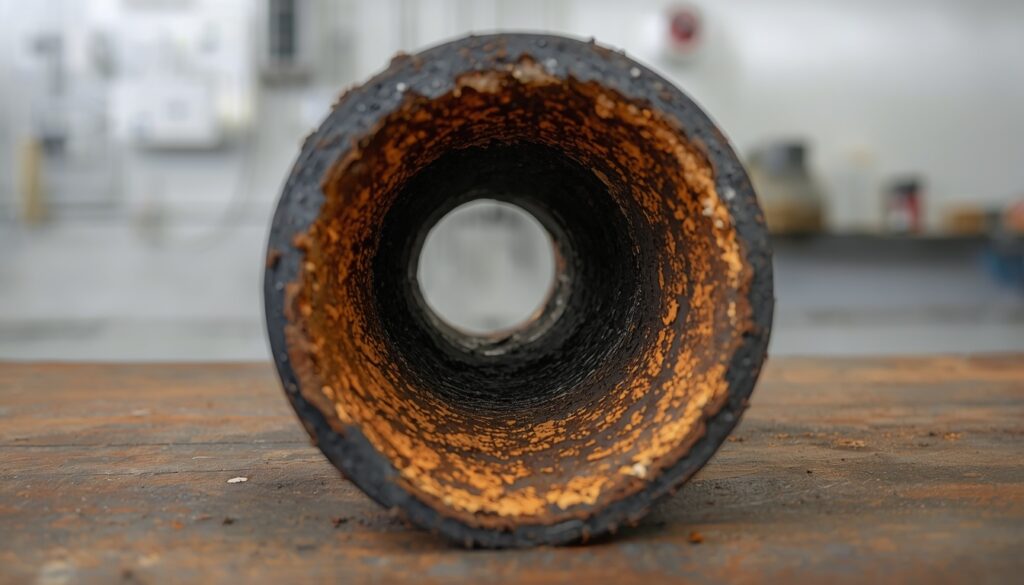
Cracked lines are common in older DFW housing for the same reason S-traps are: age. Cast iron corrodes from the inside and North Texas clay shifts seasonally, working pipe joints apart. When that is the suspicion, a camera inspection shows the interior of the pipe instead of guessing at it.
Being straight about it: an inspection diagnoses, it does not repair, and it costs money. If you have not tried the fifteen-second tap test yet, do that first. Our full breakdown of sewer smell causes walks the free checks in order.
What conversion costs
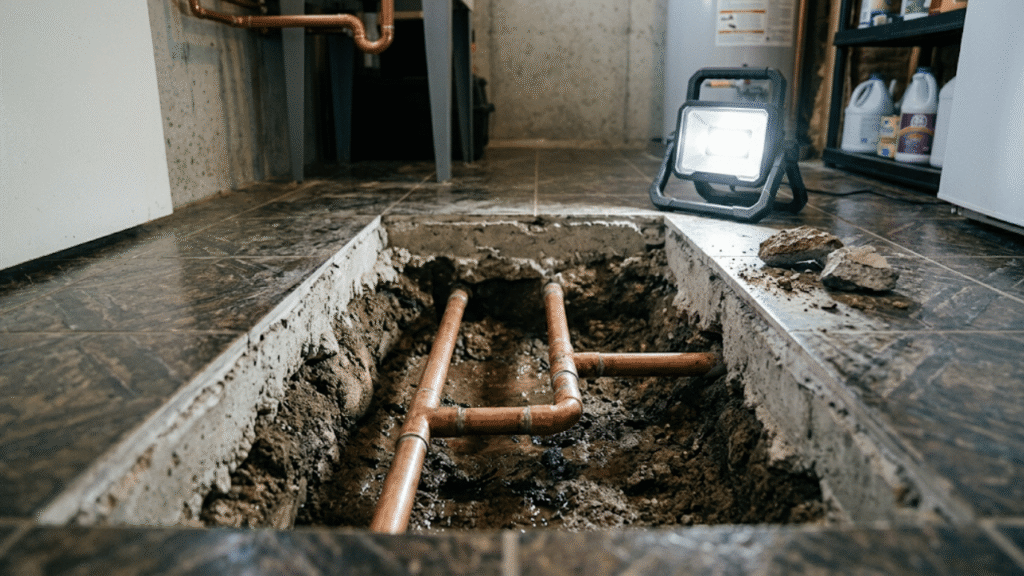
Converting an S-trap to a P-trap is not a parts swap. The drain has to be re-routed horizontally and tied to a vent, either an existing stack or an air admittance valve where local amendments permit one. That means opening a wall or a floor, and in most DFW cities it is permit work with an inspection.
| Job | Cost (as of Q3 2026) |
|---|---|
| Refill a dry trap | $0 |
| Replace a P-trap assembly (part) | $10 to $30 |
| S-trap to P-trap conversion | Quoted after inspection |
| Camera inspection | $250+ |
Pricing depends on access, whether the vent is reachable, and what the wall opens up to reveal. Nuflow DFW is licensed by the Texas State Board of Plumbing Examiners (RMP# 46694) and provides written estimates after an on-site look.
One honest note on urgency. An S-trap that has never given you trouble is not an emergency. It becomes worth fixing when you are already opening that wall, when you are selling and an inspector flags it, or when you are chasing a smell you cannot solve. We would rather tell you that than sell you a conversion you do not need this month.
Frequently Asked Questions
Are S-traps illegal?
S-traps are prohibited for new installations under both major US plumbing codes, the IPC at Section 1002.3 and the UPC at 1004.1. Existing ones in older homes are not retroactively illegal, but they get flagged during home inspections and generally have to be corrected during any permitted remodel of that fixture.
How can I tell if I have an S-trap or a P-trap?
Look at where the pipe goes after the U-bend. Straight down through the floor means an S-trap. Sideways into the wall means a P-trap. That horizontal section is the trap arm, and it is what connects to a vent. No horizontal run means no vent, which is the whole problem.
Why does my P-trap keep drying out?
Either nobody uses that fixture, or the vent serving it is blocked and the trap siphons every time something drains. Disuse is more common. In a North Texas summer an unused trap can evaporate dry in three to four weeks. If a trap in daily use keeps going dry, suspect the vent.
How far can a trap be from its vent in Dallas?
Under the IPC that Dallas and Fort Worth enforce, the limits are 5 feet for a 1¼-inch trap arm, 6 feet for 1½-inch, 8 feet for 2-inch, and 12 feet for 3-inch. Articles quoting 30 inches are citing the Uniform Plumbing Code, which DFW cities do not use.
Can I just replace an S-trap with a P-trap?
Not on its own. A P-trap needs a horizontal trap arm connecting to a vent, and an S-trap drain drops straight down with no vent to reach. The conversion means re-routing the drain and adding venting, which usually opens a wall and needs a permit in most DFW cities.
What is the weir of a trap?
The weir is the crest inside the trap that water spills over on its way to the drain. Trap seal depth is measured from the weir down, and code requires 2 to 4 inches. It matters because a vent connecting below the weir line will siphon the trap even when everything else is installed correctly.
What to check this week
Go look at the pipe under your oldest sink. If it drops straight down instead of running into the wall, you have an S-trap, and it explains any smell you have been chasing at that fixture. Then run water in every drain you never use, including floor drains, and give it a day.
If a smell survives all of that, the trap is not your problem and no amount of work under the sink will fix it.
Nuflow DFW runs 24/7 service across the Dallas-Fort Worth Metroplex. Licensed Master Plumber, RMP# 46694. Call (469) 701-0597.