Texas plumbing rules work in two separate layers, and confusing them causes most of the trouble homeowners run into. The state decides who is allowed to do plumbing work, through the Texas State Board of Plumbing Examiners under Texas Occupations Code Chapter 1301. Your city decides what the work has to meet, and enforces it through permits and inspections. The most important thing to know: Texas law does let you do plumbing in your own homestead without a license, but that exemption does not exempt you from pulling a permit or passing inspection.
That single distinction, license versus permit, is where most homeowners get caught. This guide explains what the code actually requires of you, what you can legally do yourself, when a permit is needed, what inspectors look for, and why the answer changes depending on which DFW city you live in.
What Plumbing Code Does Texas Use?
Texas Occupations Code Section 1301.255 directs the Texas State Board of Plumbing Examiners to adopt plumbing codes, specifically the Uniform Plumbing Code published by the International Association of Plumbing and Mechanical Officials and the International Plumbing Code published by the International Code Council. The board can adopt later editions of those codes by rule.
Then comes the part that matters to you. That same section lets a municipality amend provisions of the adopted code to fit local concerns, as long as the amendments do not substantially vary from board rules or conflict with state law. So while the model codes provide the technical backbone, the version and the local amendments enforced at your address are set by your city.
This is why there is no single universal answer to “what does the code require.” Two houses twenty minutes apart can be under slightly different requirements. Anyone who gives you a confident statewide answer without asking what city you are in is guessing. The authoritative answer for your address comes from your city’s building inspection or permit department.
Section 1301.255 also establishes something worth knowing: plumbing installed in compliance with an adopted code must be inspected by a plumbing inspector. Inspection is not optional paperwork; it is built into the law.
Who Regulates What
The state licenses the plumber. The Texas State Board of Plumbing Examiners (TSBPE) issues plumbing licenses under Chapter 1301, which is titled the Plumbing License Law. The license types defined in Section 1301.002 include Master Plumber, Journeyman Plumber, Tradesman Plumber-Limited, Plumbing Inspector, and Responsible Master Plumber, plus registrations for drain cleaners, residential utilities installers, and plumber’s apprentices.
The Responsible Master Plumber, or RMP, is the one homeowners should recognize. Under Section 1301.002, an RMP is the license holder whose license a plumbing company operates under, is authorized to obtain permits for plumbing work, and assumes responsibility for the work performed under that license. An RMP must also have submitted a certificate of insurance. Nuflow DFW operates under RMP# 46694, which is what allows the company to pull permits on your behalf and stand behind the work.
Your city enforces the code. Permits, inspections, local amendments, and in some cities a requirement that plumbers register with the city before pulling permits there, all happen at the municipal level.
Can a Homeowner Do Their Own Plumbing in Texas?
Yes, within limits, and the limits are the part people miss.
Texas Occupations Code Section 1301.051 is titled “Plumbing by Property Owner in Homestead,” and it says a property owner is not required to be licensed to perform plumbing in the property owner’s homestead. That is a genuine exemption, and it is broader than many homeowners assume.
But read what it exempts you from: the license. It says nothing about permits or inspections. Those are separate requirements, set by your city, and they still apply. A homeowner doing their own water heater replacement in most DFW cities still needs a permit for it and still needs it inspected.
Two more limits worth knowing. The exemption applies to your homestead, meaning the home you live in, so it does not cover rental property you own or commercial buildings. And gas piping is the area where you should stop and reconsider regardless of what the exemption allows, because the failure modes are gas leaks and carbon monoxide, and cities apply the tightest requirements there.
There are additional exemptions in the statute that do not apply to most DFW homeowners but exist: Section 1301.052 covers certain work outside municipalities or in smaller counties, and Section 1301.053 covers plumbing incidental to other professions.
When Do You Need a Permit?
Permits come from your city, so thresholds vary, but the pattern across the Metroplex is consistent enough to plan around.
Generally needs a permit: replacing a water heater, adding or rerouting water supply, drain, waste, or vent piping, repiping, sewer line repair or replacement, adding a gas line or gas appliance connection, and installing a water softener or filtration system that requires new pipe connections. As a working rule, if the project changes the location, capacity, or configuration of plumbing, assume a permit is required and verify.
Generally does not need a permit: routine maintenance and small component replacement that does not alter plumbing connections, such as swapping a water heater’s heating element, thermostat, or anode rod, or flushing the tank. Simple like-for-like fixture repairs typically fall here too, though the line varies by city.
Water heaters are the most common permit surprise, and they are worth calling out because unpermitted water heater installations are among the most frequently flagged items when a DFW home is sold. If you are weighing repair against replacement in the first place, our guide to water heater repair covers the warning signs. Permit fees for this kind of work commonly run in the range of roughly $50 to $200 depending on the city, and processing can take from a few days to longer.
The reliable way to get a definitive answer for your address is a phone call to your city’s building inspection or permit department describing the work. It is free, it takes minutes, and the answer is authoritative. When you hire a licensed plumber, pulling the permit is part of the job.
How City Rules Actually Differ: A Real Example
Garland publishes its water heater replacement requirements, and they show what “local amendments” means in practice. According to the City of Garland’s water heater replacement requirements, an installation there needs a working temperature and pressure relief valve, a T&P drain of at least three-quarter inch copper or CPVC terminating outside or at the garage floor and turned down roughly six inches, a shut-off valve on the cold water inlet, a drain pan under the heater, a gas shut-off valve within six feet of the unit and accessible in the same room, and Type B double-wall vent through concealed spaces with one inch of clearance from combustibles. Water heaters in garages must be elevated when the ignition source sits less than eighteen inches above the floor or when the manufacturer requires it.
Garland also illustrates the local-registration wrinkle. Its guidance notes that a homeowner who cannot produce the required documentation, or who is not confident doing the work, must hire a state-licensed master plumber who is registered with the City of Garland to obtain the permit. Being licensed by the state is not automatically the same as being registered to pull permits in a given city.
Details like the elevation requirement genuinely differ between cities, which is exactly why the answer to a code question depends on your address rather than on the state.
What Inspectors Check
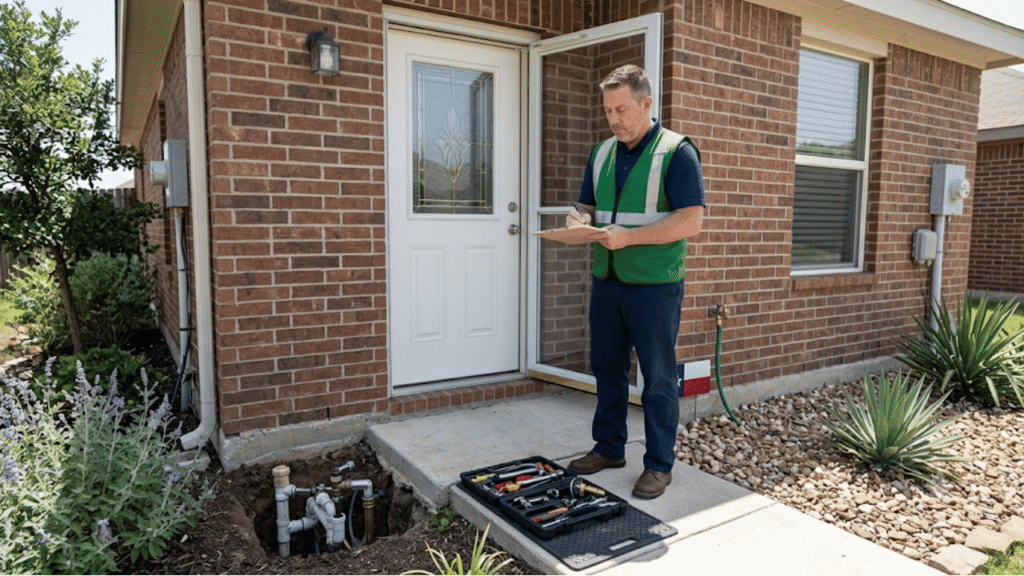
Inspection is required by statute for plumbing installed under an adopted code, and the practical sequence for most residential work is rough-in inspection while the work is still exposed, then a final inspection.
The single most important homeowner rule around inspections: do not let anyone close up permitted work before it has been inspected. If a contractor suggests backfilling a trench, closing a wall, or finishing over the work before the inspector has seen it, stop. Re-opening finished work to satisfy an inspector costs far more than waiting a day.
The Garland requirements above are a good preview of what gets checked on a water heater: relief valve operation, drain routing and material, shut-off valves, the pan, venting clearances, combustion air, and elevation where required. Expansion tanks come up often in newer DFW homes too, because a home with a pressure-reducing valve, check valve, or backflow preventer on the supply line has a closed system, and a closed system needs somewhere for thermal expansion to go.
Why Unpermitted Work Costs More Later
Skipping the permit saves a small fee now and creates three exposures.
Insurance disputes.
If a plumbing failure causes water damage and the work behind it was unpermitted or non-compliant, an insurer has grounds to contest the claim. The repair is one bill; a denied water damage claim is a much larger one.
Home sale problems
Unpermitted plumbing work surfaces during inspection, and buyers respond by asking for permits, a price reduction, or for the work to be redone properly. It becomes a negotiation at the moment you have the least leverage. Your city’s permit records show what was pulled for your address, which is worth checking before you list.
Safety
The requirements around venting, relief valves, gas connections, and backflow prevention exist because those failures injure people.
Red Flags and Questions Worth Asking
Signs earlier work may have been done off the books: the contractor offered a cash discount for skipping the permit, you have no permit number or inspection record, work was closed up unusually fast, the plumber would not give a license number, or a recurring problem was “fixed” without anyone ever looking inside the line.
Before any plumbing job, five questions sort a licensed operation from a risk. What is your license number, and is it current with TSBPE? Does this job need a permit, and will you pull it? Will there be an inspection, and at what stage? Can I get the scope and price in writing first? And on a diagnostic job, will you show me what you found rather than just telling me?
That last one matters more than people expect. On a recurring drain or sewer problem, a sewer camera inspection produces video you can keep, which is the difference between a diagnosis you can verify and a claim you have to accept on faith.
Frequently Asked Questions About Texas Plumbing Code
What plumbing code does Texas use?
Texas Occupations Code Section 1301.255 directs the Texas State Board of Plumbing Examiners to adopt the Uniform Plumbing Code and the International Plumbing Code, and allows the board to adopt later editions by rule. The same section lets municipalities amend the code for local concerns, so the exact version and requirements enforced depend on your city.
Can a homeowner do their own plumbing work in Texas?
Yes, with limits. Texas Occupations Code Section 1301.051 says a property owner does not need a license to perform plumbing in their own homestead. That exemption covers the license only, not permits or inspections, which your city still requires. It also applies to your own residence, not rental or commercial property.
Do I need a permit to replace a water heater in Texas?
In most Texas cities, yes. Water heater replacement involves gas or electrical connections, venting, relief valves, and water supply, so cities across DFW require a permit and a final inspection. The homeowner license exemption does not remove the permit requirement. Confirm the process with your city’s permit office before starting.
How are plumbing codes enforced in Texas?
Enforcement happens locally through permits and inspections. Texas Occupations Code Section 1301.255 requires that plumbing installed under an adopted code be inspected by a plumbing inspector, and cities administer that through their building inspection departments. Separately, TSBPE regulates plumber licensing statewide under Chapter 1301.
How do I check if a plumber is licensed in Texas?
Ask for the license number directly and verify it through the Texas State Board of Plumbing Examiners, confirming it is current. Licenses attach to individuals, not just company names, so a business name alone is not verification. For work needing a permit, also ask whether the plumber is registered to pull permits in your city, since some cities require that separately.
What happens if plumbing work was done without a permit?
Unpermitted work can give an insurer grounds to contest a water damage claim, and it commonly surfaces during a home sale inspection, where buyers ask for permits, price reductions, or for the work to be redone. Your city’s permit records show what was pulled for your address, so it is worth checking before you list.
What is a Responsible Master Plumber?
Under Texas Occupations Code Section 1301.002, a Responsible Master Plumber is the master plumber whose license a plumbing company operates under. An RMP is authorized to obtain permits for plumbing work, assumes responsibility for work performed under that license, and must have submitted a certificate of insurance. Nuflow DFW operates under RMP# 46694.
The Bottom Line
Remember the two layers. The state, through TSBPE and Chapter 1301, decides who may do the work. Your city decides what the work must meet and verifies it through permits and inspection. And remember the distinction inside the homeowner exemption: Section 1301.051 frees you from needing a license on your own homestead, not from needing a permit.
When someone tells you something is or is not up to code, the useful follow-up questions are which city’s code, which edition, and can you show me. For anything that needs a permit and an inspection, hiring licensed is partly about workmanship and partly about the paperwork that protects you at claim time and at closing.
Nuflow DFW is licensed by the Texas State Board of Plumbing Examiners (RMP# 46694), pulls permits as part of the job, and provides trenchless pipe repair and 24/7 service across the Dallas-Fort Worth Metroplex. Call (469) 701-0597 with questions about permits or code on your project.